
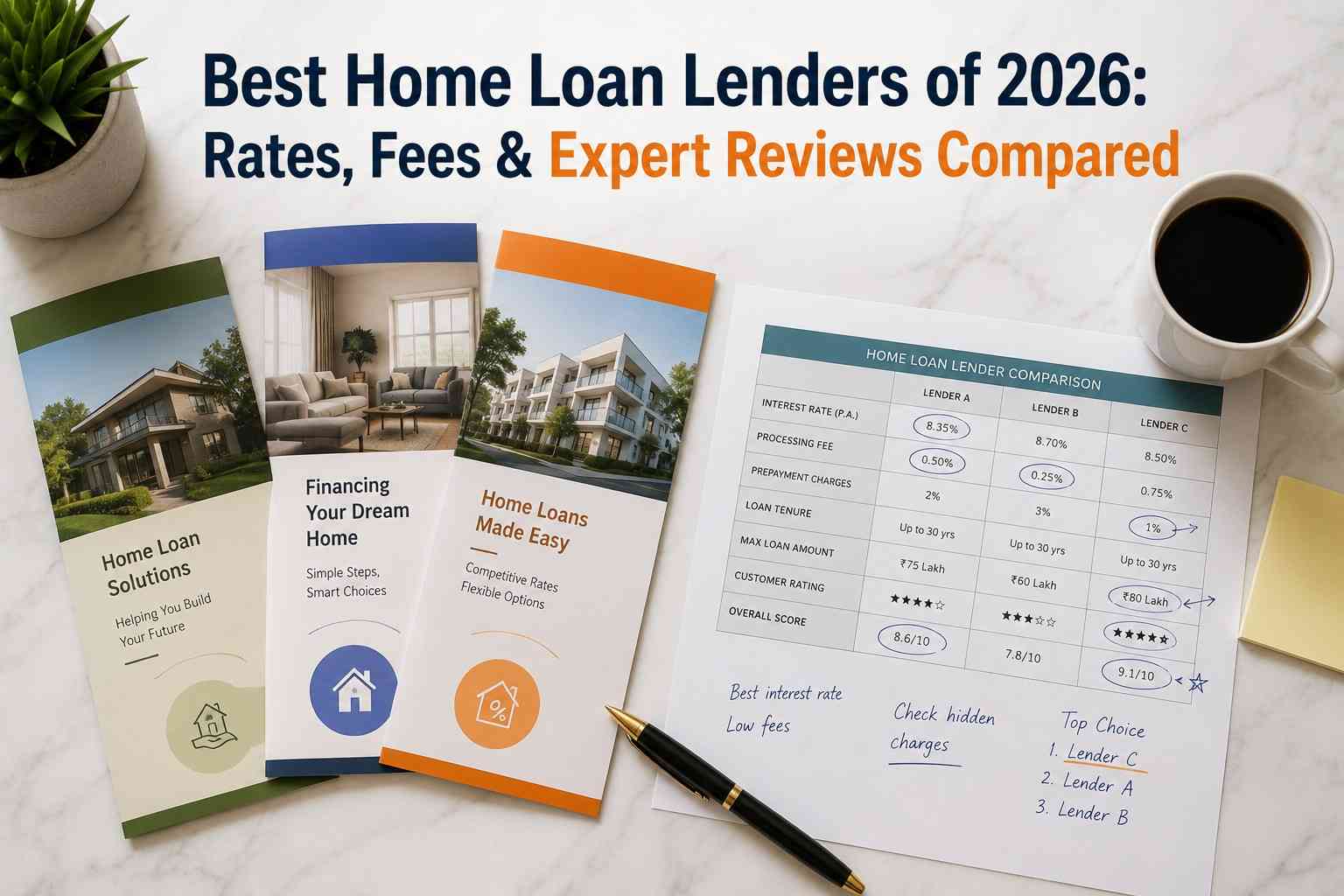
Mortgage rates are quoted everywhere—on billboards, in bank lobbies, in endless online ads. Almost nobody explains what the number actually means for your specific situation, how a mortgage rates comparison looks relative to what you could actually qualify for, or what the difference between a 6.75% and 7.25% rate means in real monthly dollars over thirty years. Those are the things that matter.
Current mortgage rates in 2026: 30-year fixed conventional sits in the 6.75%-7.50% range (as of mid-2026, subject to Fed policy movement), 15-year fixed is approximately 6.00%-6.75%, FHA 30-year fixed runs 6.50%-7.25%, VA loans average 6.25%-7.00%, and adjustable-rate mortgages (5/1 ARM) open around 6.25%-7.00% before adjusting. The rate you personally qualify for depends heavily on your credit score, down payment, loan-to-value ratio, and lender.
Mortgage Rate Basics: What You’re Actually Comparing
| Term | What It Means | Why It Matters |
|---|---|---|
| Interest Rate | The base cost of borrowing, expressed annually | Used to calculate your monthly principal + interest payment |
| APR (Annual Percentage Rate) | Interest rate + lender fees (origination, points, etc.) expressed as a single rate | Better for comparing total cost across lenders – always compare APR, not just rate |
| Points | 1 point = 1% of loan amount paid upfront to reduce interest rate | Buying points can save money if you stay in the home long enough to break even |
| Rate Lock | Agreement from lender to hold your rate for 30-60-90 days while you close | Protects you if rates rise during the closing process |
| Fixed vs. ARM | Fixed: same rate for life of loan. ARM: fixed for intro period, then adjusts annually | Fixed = certainty. ARM = lower initial rate with adjustment risk after intro period |
Current Mortgage Rates by Loan Type – 2026 Reference
| Loan Type | Rate Range (2026) | Best For | Key Notes |
|---|---|---|---|
| 30-Year Fixed Conventional | 6.75% – 7.50% | Most buyers – predictable, long-term stability | Most common loan type; requires 3-20% down depending on lender |
| 15-Year Fixed Conventional | 6.00% – 6.75% | Those who can afford higher payment and want to build equity fast | Saves significantly in total interest vs. 30-year |
| 20-Year Fixed Conventional | 6.40% – 7.10% | Middle ground between 15 and 30 year | Less common but worth quoting if payoff timeline matters |
| FHA 30-Year Fixed | 6.50% – 7.25% | First-time buyers, credit scores 580-680 | 3.5% down with 580+ score; mortgage insurance required |
| VA Loan (30-Year) | 6.25% – 7.00% | Active military, veterans, eligible spouses | No down payment required; no PMI; best rate for qualified borrowers |
| USDA Loan (30-Year) | 6.00% – 6.75% | Rural and suburban buyers meeting income limits | No down payment; geographic and income eligibility requirements |
| Jumbo Loan (30-Year Fixed) | 7.00% – 8.00%+ | Loan amounts above conforming limit ($766,550 in most areas) | Stricter underwriting; 10-20% down typically required |
| 5/1 ARM | 6.25% – 7.00% | Buyers who plan to sell or refinance within 5-7 years | Lower initial rate; adjusts annually after 5-year fixed period |
| 7/1 ARM | 6.50% – 7.25% | Buyers planning to stay 7+ years but expect rates to fall | 7-year fixed then annual adjustments; caps limit how much it can rise |
30-Year vs. 15-Year vs. 20-Year: Real Payment Comparison
Loan amount: $350,000. No PMI. Rates as of mid-2026 estimates.
| Loan Term | Rate | Monthly Payment (P+I) | Total Interest Paid | Total Cost |
|---|---|---|---|---|
| 30-Year Fixed | 7.10% | $2,354 | $497,563 | $847,563 |
| 20-Year Fixed | 6.70% | $2,657 | $287,626 | $637,626 |
| 15-Year Fixed | 6.40% | $3,020 | $193,644 | $543,644 |
The 15-year loan saves $303,919 in interest compared to the 30-year – but requires $666 more per month. The 20-year is an underutilised option that saves $209,937 in interest with only $303 more per month than the 30-year. If the 20-year payment is achievable, it offers remarkable value relative to its payment premium.
How Your Credit Score Affects Your Mortgage Rate
| FICO Score Range | Typical 30-Year Rate | Monthly Payment ($350K loan) | vs. 760+ Score |
|---|---|---|---|
| 760 – 850 (Excellent) | 6.75% – 7.00% | ~$2,271 – $2,329 | Baseline |
| 720 – 759 (Very Good) | 7.00% – 7.25% | ~$2,329 – $2,389 | +$58 – $118/mo |
| 680 – 719 (Good) | 7.25% – 7.75% | ~$2,389 – $2,512 | +$118 – $241/mo |
| 640 – 679 (Fair) | 7.75% – 8.50% | ~$2,512 – $2,691 | +$241 – $420/mo |
| 580 – 639 (Poor) | 8.50%+ or FHA only | $2,691+ | $420+ more per month |
A 760+ vs. a 680 credit score on a $350,000 mortgage can mean $150-$240 more per month – that is $1,800-$2,880 per year, or $54,000-$86,400 over the life of a 30-year loan. Spending 6-12 months improving your credit score before applying is one of the highest-return financial moves available to a prospective homebuyer.
Where to Get the Best Mortgage Rate
| Lender Type | Typical Rate | Pros | Cons |
|---|---|---|---|
| Credit Unions | Slightly below average | Member-owned, lower fees, personalised service | Membership requirement, may have fewer product options |
| Mortgage Brokers | Access to multiple lenders | Can shop dozens of lenders on your behalf, negotiate | Broker fee (often 0.5-1% of loan); not all lenders work with brokers |
| Online Lenders (Better, Rocket, loanDepot) | Competitive – often 0.125-0.25% below big banks | Fast process, transparent quotes, strong rate tools | Less hand-holding; primarily digital relationship |
| Big Banks (Chase, Wells, BofA) | At or slightly above market | Existing relationship discounts, branch access | Rates less competitive; slower process |
| Community Banks | Competitive locally | Portfolio lending (flexible underwriting), local knowledge | Smaller loan limits, geographic restrictions |
Should You Buy Points?
Buying discount points (paying 1% of the loan upfront to reduce the rate by approximately 0.25%) makes financial sense only if you stay in the home long enough to break even on the upfront cost.
| Scenario | Detail |
|---|---|
| Loan amount | $350,000 |
| Cost of 1 point | $3,500 |
| Rate reduction from 1 point | Approximately 0.25% (e.g., 7.25% → 7.00%) |
| Monthly savings | ~$58/month |
| Break-even period | $3,500 ÷ $58 = 60 months (5 years) |
| Worth it if… | You stay in the home 5+ years and do not refinance before then |
| Not worth it if… | You plan to sell, move, or refinance within 3-4 years |
How to Shop for the Best Rate: A Practical Approach
- Get pre-approved by at least 3 lenders – not just pre-qualified. Pre-approval involves a hard credit pull, but multiple mortgage inquiries within a 14-45 day window count as a single inquiry for scoring purposes
- Always compare APR, not just the interest rate – a lender with a slightly lower rate but higher fees may cost more overall
- Ask each lender for a Loan Estimate on the same day – rates move daily, so comparing estimates from different dates is comparing different markets
- Negotiate – lenders will often match or beat a competitor’s rate when shown a written Loan Estimate
- Consider a mortgage broker – they have access to wholesale rates from multiple lenders and can often find products that direct-to-consumer lenders do not offer
- Lock your rate once you have a purchase agreement – 45-60 day locks are standard; longer locks cost slightly more but protect you in a rising rate environment
The mortgage rate environment in 2026 has normalised from the extreme lows of 2020-2021 and the rapid rise of 2022-2023. Rates are higher than a generation of homeowners experienced – but they are not historically unusual. The discipline of shopping multiple lenders, improving credit before applying, and choosing the right loan term for your financial situation remains the most powerful tool available to a mortgage borrower regardless of where rates sit.
